b_asic.scheduler
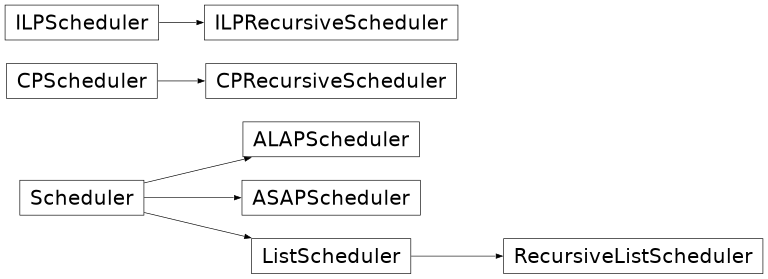
B-ASIC Scheduler Module.
Contains classes for automatic scheduling of SFGs.
- class b_asic.scheduler.ALAPScheduler(input_times: dict[GraphID, int] | None = None, output_delta_times: dict[GraphID, int] | None = None, output_times: dict[GraphID, int] | None = None, sort_y_location: bool = True)
Bases:
SchedulerScheduler that implements the as-late-as-possible (ALAP) algorithm.
- Parameters:
- input_timesdict(
GraphID, int), optional The times when inputs arrive.
- output_delta_timesdict(
GraphID, int), optional The relative times when outputs should be produced.
- output_timesdict(
GraphID, int), optional The times when outputs should be produced.
- sort_y_locationbool, default: True
If the y-location should be sorted based on start time of operations.
- input_timesdict(
- class b_asic.scheduler.ASAPScheduler(input_times: dict[GraphID, int] | None = None, output_delta_times: dict[GraphID, int] | None = None, output_times: dict[GraphID, int] | None = None, sort_y_location: bool = True)
Bases:
SchedulerScheduler that implements the as-soon-as-possible (ASAP) algorithm.
- Parameters:
- input_timesdict(
GraphID, int), optional The times when inputs arrive.
- output_delta_timesdict(
GraphID, int), optional The relative times when outputs should be produced.
- output_timesdict(
GraphID, int), optional The times when outputs should be produced.
- sort_y_locationbool, default: True
If the y-location should be sorted based on start time of operations.
- input_timesdict(
- class b_asic.scheduler.CPRecursiveScheduler(solver: str | SolverInterface | None = None, input_times: dict[GraphID, int] | None = None, output_delta_times: dict[GraphID, int] | None = None, output_times: dict[GraphID, int] | None = None, max_time: int | None = None, sort_y_location: bool = True, **kwargs)
Bases:
CPSchedulerConstraint programming scheduler for algorithms with feedback through delays.
Minimize the sum of peak resource counts, including I/O, using the same per-connection feedback constraints as
ILPRecursiveScheduler. Search the full scheduling horizon rather than restricting start times to ASAP/ALAP bounds, so iterations may overlap even when the period is shorter than the ASAP schedule length.Accepts the same parameters and solver options as
CPScheduler.max_timeextends the absolute horizon for cyclic schedules; the Schedule’sschedule_timespecifies the iteration period. Without an explicit period, use the ASAP schedule length. Requires the optionalcpdependencies (pip install b-asic[cp]).Compact I/O slack after solving as in
ILPRecursiveScheduler, preserving fixed input times and relative output offsets. Fixed output times disable this compaction.Examples
from b_asic import CPRecursiveScheduler, Schedule

schedule = Schedule(
    sfg, CPRecursiveScheduler(max_time=20),
    schedule_time=10, cyclic=True,
)
- class b_asic.scheduler.CPScheduler(solver: str | SolverInterface | None = None, input_times: dict[GraphID, int] | None = None, output_delta_times: dict[GraphID, int] | None = None, output_times: dict[GraphID, int] | None = None, max_time: int | None = None, sort_y_location: bool = True, **kwargs)
Bases:
_OptimizationSchedulerConstraint programming scheduler minimizing concurrent operations and I/O.
Minimizes the sum of peak resource counts for each operation type, including I/O. For cyclic schedules, resource constraints count overlap between successive iterations. I/O timing constraints tighten resource bounds, and a feasible ASAP schedule is supplied as a warm start when the solver supports solution hints.
Requires the optional
cpdependencies (pip install b-asic[cp]).- Parameters:
- solverstr or
SolverInterface, optional CPMpy solver name (default:
"ortools") or a fresh solver instance. Constraints and the objective are added to supplied instances in place, preserving native solver settings.- input_timesdict(GraphID, int), optional
The times when inputs arrive.
- output_delta_timesdict(GraphID, int), optional
Output offsets relative to a common time chosen by the solver. The outputs may move together within the scheduling horizon.
- output_timesdict(GraphID, int), optional
The times when outputs should be produced. For cyclic schedules these specify the time within the schedule period.
- max_timeint, optional
The time horizon to schedule for in cyclic scheduling. The iteration period is specified by the Schedule’s
schedule_timeparameter.- sort_y_locationbool, default: True
If the y-location should be sorted based on start time of operations.
- **kwargsAny
Options passed to the CPMpy solver’s
solve()method, for exampletime_limit=60or, for OR-Tools,num_search_workers=4.
- solverstr or
Examples
Schedule an SFG with a given schedule time:
from b_asic import CPScheduler, Schedule

schedule = Schedule(sfg, CPScheduler(), schedule_time=20)
- class b_asic.scheduler.ILPRecursiveScheduler(solver: LpSolver | None = None, input_times: dict[GraphID, int] | None = None, output_delta_times: dict[GraphID, int] | None = None, output_times: dict[GraphID, int] | None = None, max_time: int | None = None, sort_y_location: bool = True)
Bases:
ILPSchedulerILP scheduler for algorithms with feedback through delays.
Minimize the sum of peak resource counts, including I/O, for a fixed iteration period. Each input connection contributes its own precedence constraint, with one period of available time per intervening Delay. Latency offsets determine data availability; execution times determine resource occupancy, including overlap between cyclic iterations.
Accepts the same parameters as
ILPScheduler.max_timeis an optional absolute scheduling horizon for cyclic schedules, allowing operations to span several iterations before folding into the period. Withoutschedule_time, use the ASAP schedule length as the period. Output delta times are relative to a common time chosen by the solver. Unless output times are fixed, compact I/O slack after solving. Unspecified inputs start at zero; the other operations rotate together to remove input slack, and outputs move earlier while preserving specified output deltas.Examples
from b_asic import ILPRecursiveScheduler, Schedule

schedule = Schedule(
    sfg, ILPRecursiveScheduler(), schedule_time=10, cyclic=True
)
- class b_asic.scheduler.ILPScheduler(solver: LpSolver | None = None, input_times: dict[GraphID, int] | None = None, output_delta_times: dict[GraphID, int] | None = None, output_times: dict[GraphID, int] | None = None, max_time: int | None = None, sort_y_location: bool = True)
Bases:
_OptimizationSchedulerILP-based scheduler that minimizes the sum of per-type resource counts.
Resource occupancy is determined by execution time. For cyclic schedules, occupancy includes overlap between successive iterations.
- Parameters:
- solver
LpSolver, optional import pulp print(pulp.listSolvers(onlyAvailable=True))
- input_timesdict(
GraphID, int), optional The times when inputs arrive.
- output_delta_timesdict(
GraphID, int), optional Output offsets relative to a common time chosen by the solver. The outputs may move together within the scheduling horizon.
- output_timesdict(
GraphID, int), optional The times when outputs should be produced.
- max_timeint, optional
The time horizon to schedule for in cyclic scheduling.
- sort_y_locationbool, default: True
If the y-location should be sorted based on start time of operations.
- solver
- class b_asic.scheduler.ListScheduler(sort_order: tuple[tuple[int, bool], ...], max_resources: dict[TypeName, int] | None = None, max_concurrent_reads: int | None = None, max_concurrent_writes: int | None = None, input_times: dict[GraphID, int] | None = None, output_delta_times: dict[GraphID, int] | None = None, output_times: dict[GraphID, int] | None = None, sort_y_location: bool = True)
Bases:
SchedulerList-based scheduler with optional constraints.
Important
Only works on non-recursive SFGs. For recursive SFGs use
RecursiveListSchedulerinstead.- Parameters:
- sort_ordertuple(tuple(int, bool))
Specifies which columns in the priority table to sort on and in which order, where True is ascending order. There are five columns:
0 - GraphID of the operation.
1 - Deadline, i.e., the clock cycle that the data is required in the ALAP schedule.
2 - Output slack, i.e., the start time of the operation in the ALAP schedule when sorted on.
3 - Fan-out, i.e., the number of operations reading from the output of the operation.
4 - Memory reads, i.e., the number of memory reads required if operation is scheduled in the
    current time slot.
- max_resourcesdict[
TypeName, int], optional Max resources available to realize the schedule.
- max_concurrent_readsint, optional
Max number of concurrent reads.
- max_concurrent_writesint, optional
Max number of concurrent writes.
- input_timesdict(
GraphID, int), optional The times when inputs arrive.
- output_delta_timesdict(
GraphID, int), optional The relative times when outputs should be produced.
- output_timesdict(
GraphID, int), optional The times when outputs should be produced.
- sort_y_locationbool, default: True
If the y-location should be sorted based on start time of operations.
- class b_asic.scheduler.RecursiveListScheduler(sort_order: tuple[tuple[int, bool], ...], max_resources: dict[TypeName, int] | None = None, input_times: dict[GraphID, int] | None = None, output_delta_times: dict[GraphID, int] | None = None, output_times: dict[GraphID, int] | None = None, sort_y_location: bool = True)
Bases:
ListSchedulerList-based scheduler for recursive algorithms with optional constraints.
Info
If the SFG does not have any recursive parts, use
ListSchedulerinstead.- Parameters:
- sort_ordertuple(tuple(int, bool))
Specifies which columns in the priority table to sort on and in which order, where True is ascending order. There are five columns:
0 - GraphID of the operation.
1 - Deadline, i.e., the clock cycle that the data is required in the ALAP schedule.
2 - Output slack, i.e., the start time of the operation in the ALAP schedule when sorted on.
3 - Fan-out, i.e., the number of operations reading from the output of the operation.
4 - Memory reads, i.e., the number of memory reads required if operation is scheduled in the
    current time slot.
- max_resourcesdict[
TypeName, int], optional Max resources available to realize the schedule.
- input_timesdict(
GraphID, int), optional The times when inputs arrive.
- output_delta_timesdict(
GraphID, int), optional The relative times when outputs should be produced.
- output_timesdict(
GraphID, int), optional The times when outputs should be produced.
- sort_y_locationbool, default: True
If the y-location should be sorted based on start time of operations.
- class b_asic.scheduler.Scheduler(input_times: dict[GraphID, int] | None = None, output_delta_times: dict[GraphID, int] | None = None, output_times: dict[GraphID, int] | None = None, sort_y_location: bool = True)
Bases:
ABCScheduler base class.
- Parameters:
- input_timesdict(
GraphID, int), optional The times when inputs arrive.
- output_delta_timesdict(
GraphID, int), optional The relative times when outputs should be produced.
- output_timesdict(
GraphID, int), optional The times when outputs should be produced.
- sort_y_locationbool, default: True
If the y-location should be sorted based on start time of operations.
- input_timesdict(