Note
Go to the end to download the full example code.
Deriving a polyphase FIR decimator
Unfold a six-tap FIR filter by three, discard two output phases using Sink nodes, and propagate the unused results backwards. The resulting polyphase decimator consumes three consecutive input samples per iteration and produces one output sample at a third of the input rate.
import numpy as np

from b_asic.sfg_generators import fir
from b_asic.simulation import Simulation
from b_asic.utility_operations import Sink
Start with a small FIR filter. With three phases, these six coefficients give two taps per phase.
coefficients = np.array([0.1, 0.2, 0.3, 0.4, 0.5, 0.6])
fir_sfg = fir(coefficients)
fir_sfg.input_operations[0].name = "x"
fir_sfg.output_operations[0].name = "y"
fir_sfg

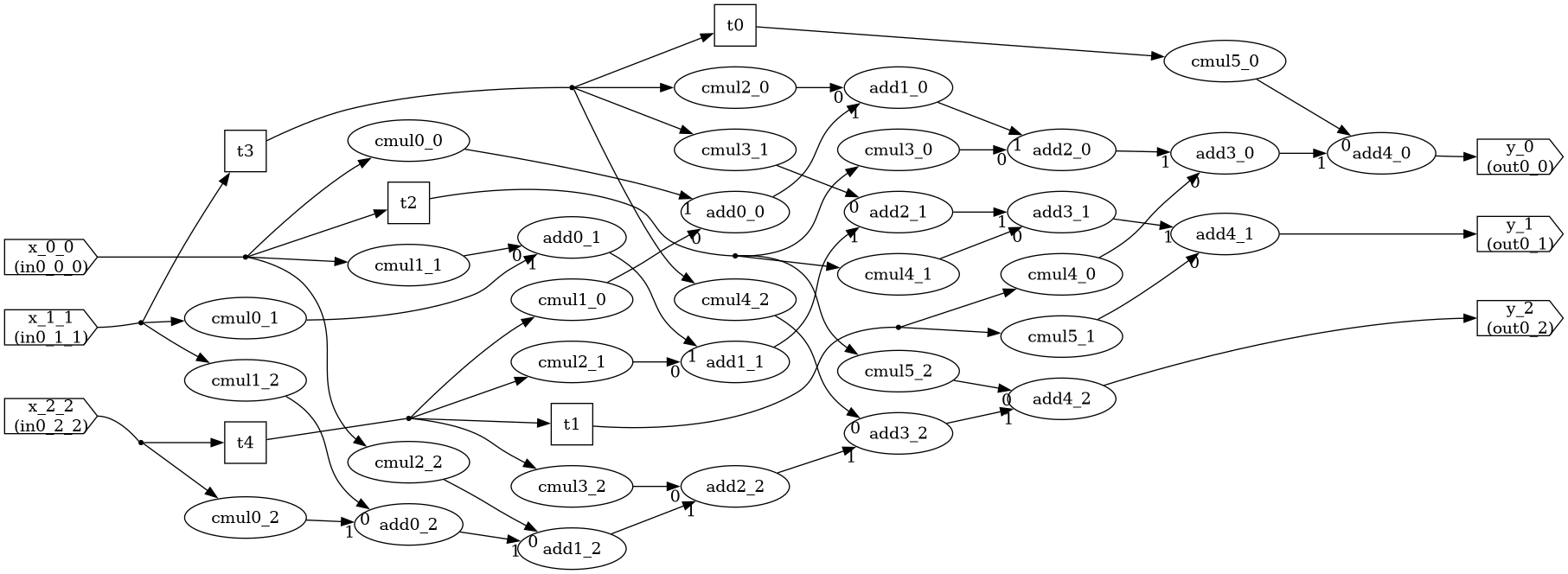
Unfold by three. The input/output ports are in chronological order, so each iteration now processes three consecutive samples and computes three outputs.
factor = 3
unfolded = fir_sfg.unfold(factor)
unfolded
Retain output phase zero: y[0], y[3], y[6], … . Replacing the other two Output nodes by Sinks removes their ports from the graph interface and marks the corresponding values as unused, while keeping the branches visible.
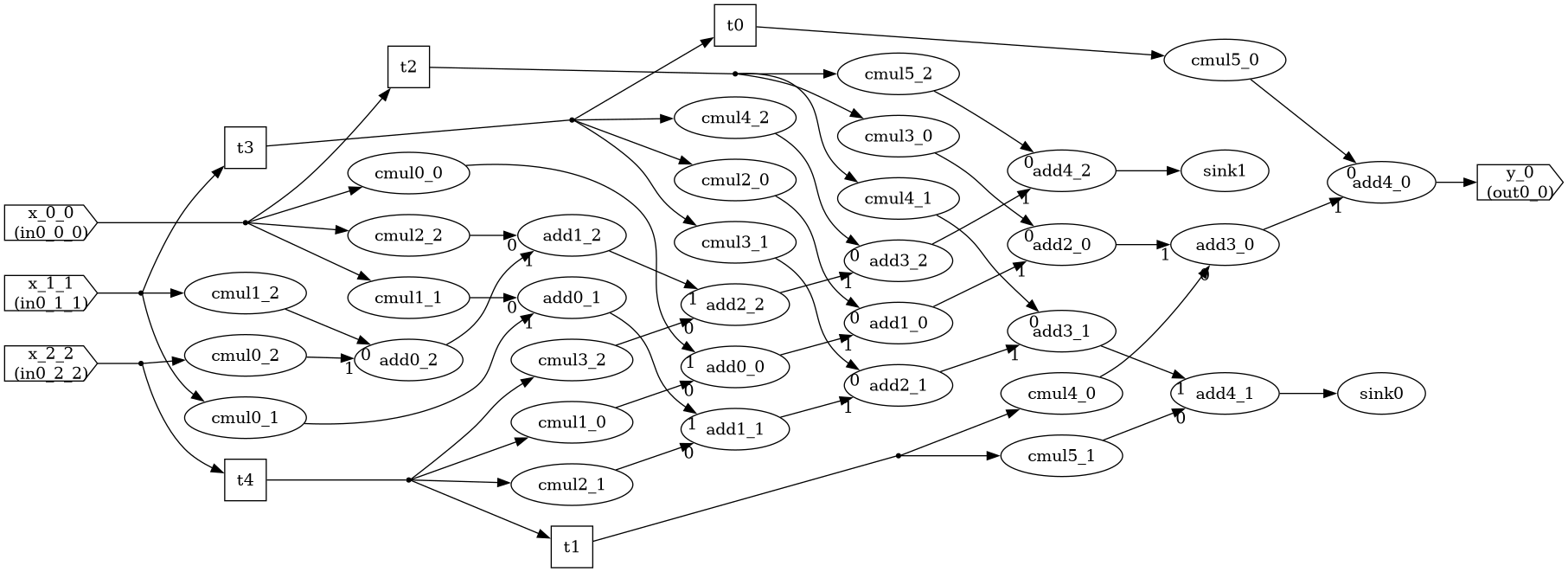
/home/runner/work/b-asic/b-asic/galleries/examples/design_examples/polyphase_decimator.py:40: UserWarning: Output port out0_1 has been removed
  sink_connected = sink_connected.replace(output.graph_id, Sink())
/home/runner/work/b-asic/b-asic/galleries/examples/design_examples/polyphase_decimator.py:40: UserWarning: Output port out0_2 has been removed
  sink_connected = sink_connected.replace(output.graph_id, Sink())
Propagate Sinks backwards. Computations serving only discarded phases are removed; shared input history needed by the retained phase is preserved. All three input phases contribute to the remaining decimated output.
polyphase = sink_connected.sink_propagation()
polyphase.name = "Three-phase FIR decimator"
polyphase
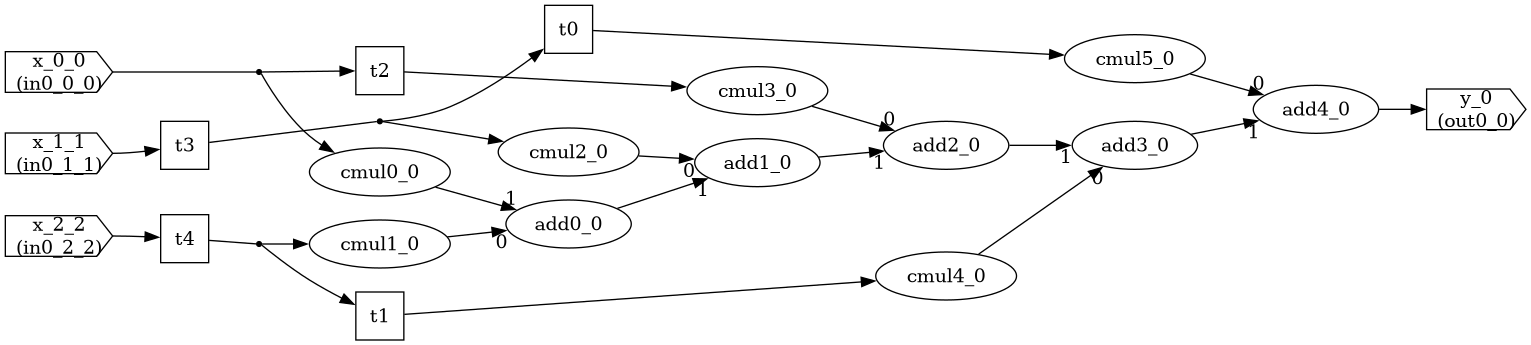
Verify against FIR filtering followed by retaining every third sample. Input port r receives x[3k + r] at iteration k. Each graph delay now stores history across three input samples, i.e. one low-rate iteration.
samples = np.array([1.0, -2.0, 3.0, 0.5, 2.0, -1.0, 0.0, 0.0, 0.0])
inputs = [samples[phase::factor] for phase in range(factor)]
simulation = Simulation(polyphase, inputs)
simulation.run()
decimated = simulation.results[polyphase.output_operations[0].graph_id]
reference = np.convolve(samples, coefficients)[: len(samples) : factor]
np.testing.assert_allclose(decimated, reference, atol=1e-14)
print("Polyphase outputs match FIR filtering followed by decimation by three.")
Polyphase outputs match FIR filtering followed by decimation by three.
Total running time of the script: (0 minutes 0.229 seconds)