Note
Go to the end to download the full example code.
Matrix Inversion
In this example, the process of deriving a time-multiplexed architecture for matrix inversion is demonstrated.
Create a signal-flow-graph (SFG) using a provided generator
from b_asic.sfg_generators.matrix_inversion import ldlt_matrix_inverse


sfg = ldlt_matrix_inverse(
    N=4,
    mode="mult",
    pe="addsub",
)
Display the number of operations in the SFG
Display the SFG
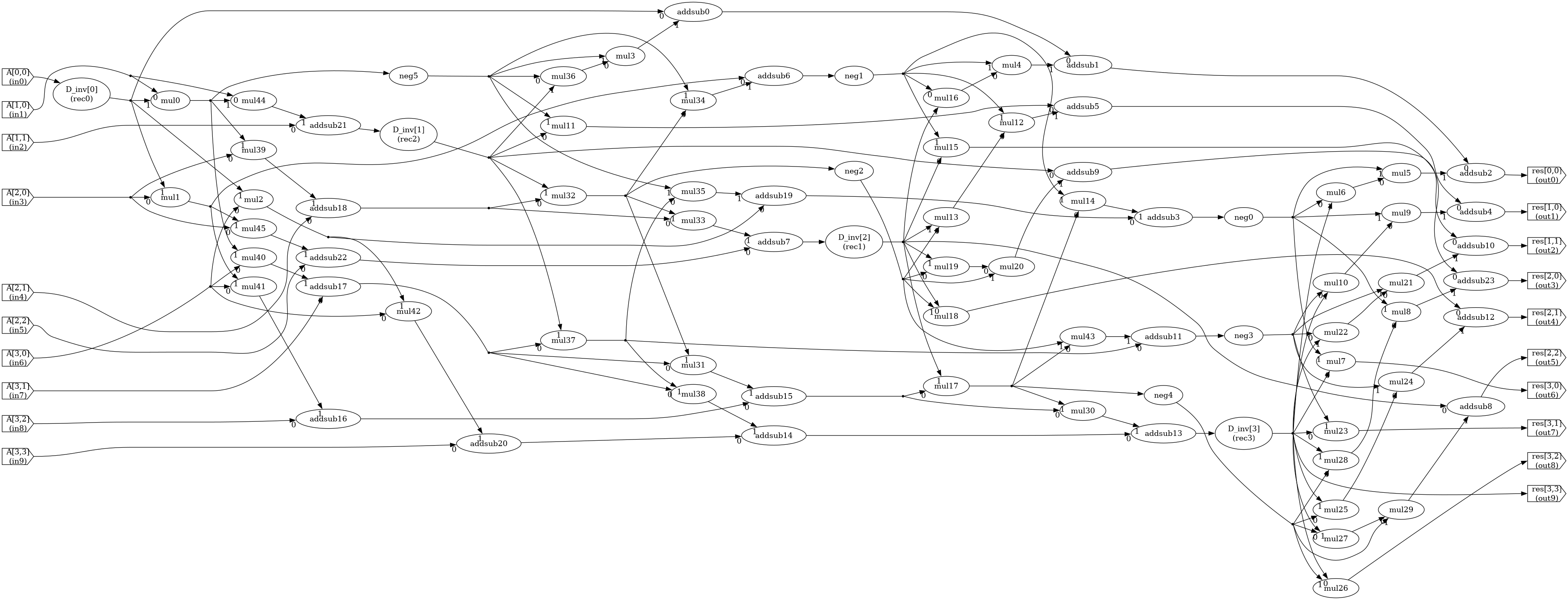
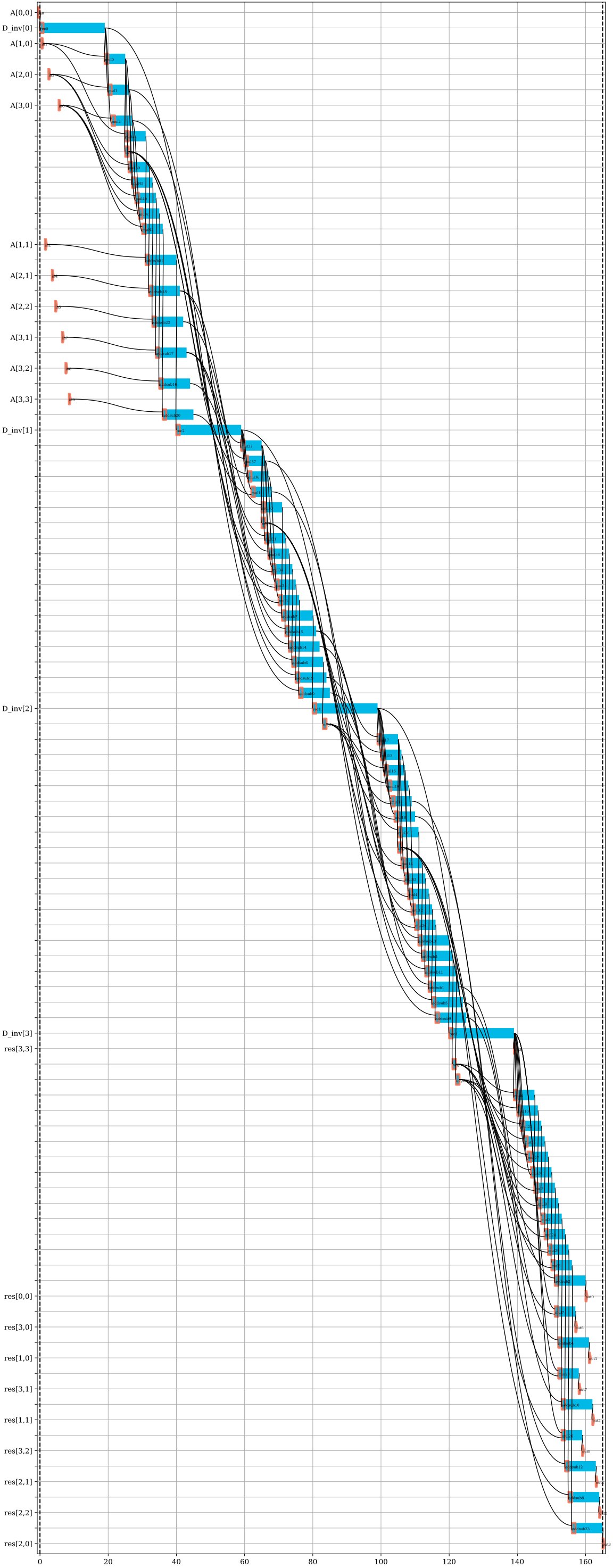
Schedule the operations from the SFG using a list-based scheduling heuristic Use 1 addsub PE, 1 mul PE, 1 reciprocal PE, 1 negation PE, 1 input port, and 1 output port.
from b_asic.list_schedulers import HybridScheduler
from b_asic.schedule import Schedule

sfg.set_latency_of_type_name("addsub", 9)
sfg.set_latency_of_type_name("mul", 6)
sfg.set_latency_of_type_name("rec", 19)
sfg.set_latency_of_type_name("neg", 1)

sfg.set_execution_time_of_type_name("addsub", 1)
sfg.set_execution_time_of_type_name("mul", 1)
sfg.set_execution_time_of_type_name("rec", 1)
sfg.set_execution_time_of_type_name("neg", 1)

resources = {
    "addsub": 1,
    "mul": 1,
    "rec": 1,
    "neg": 1,
    "in": 1,
    "out": 1,
}

scheduler = HybridScheduler(max_resources=resources)
schedule = Schedule(sfg, scheduler=scheduler)
schedule
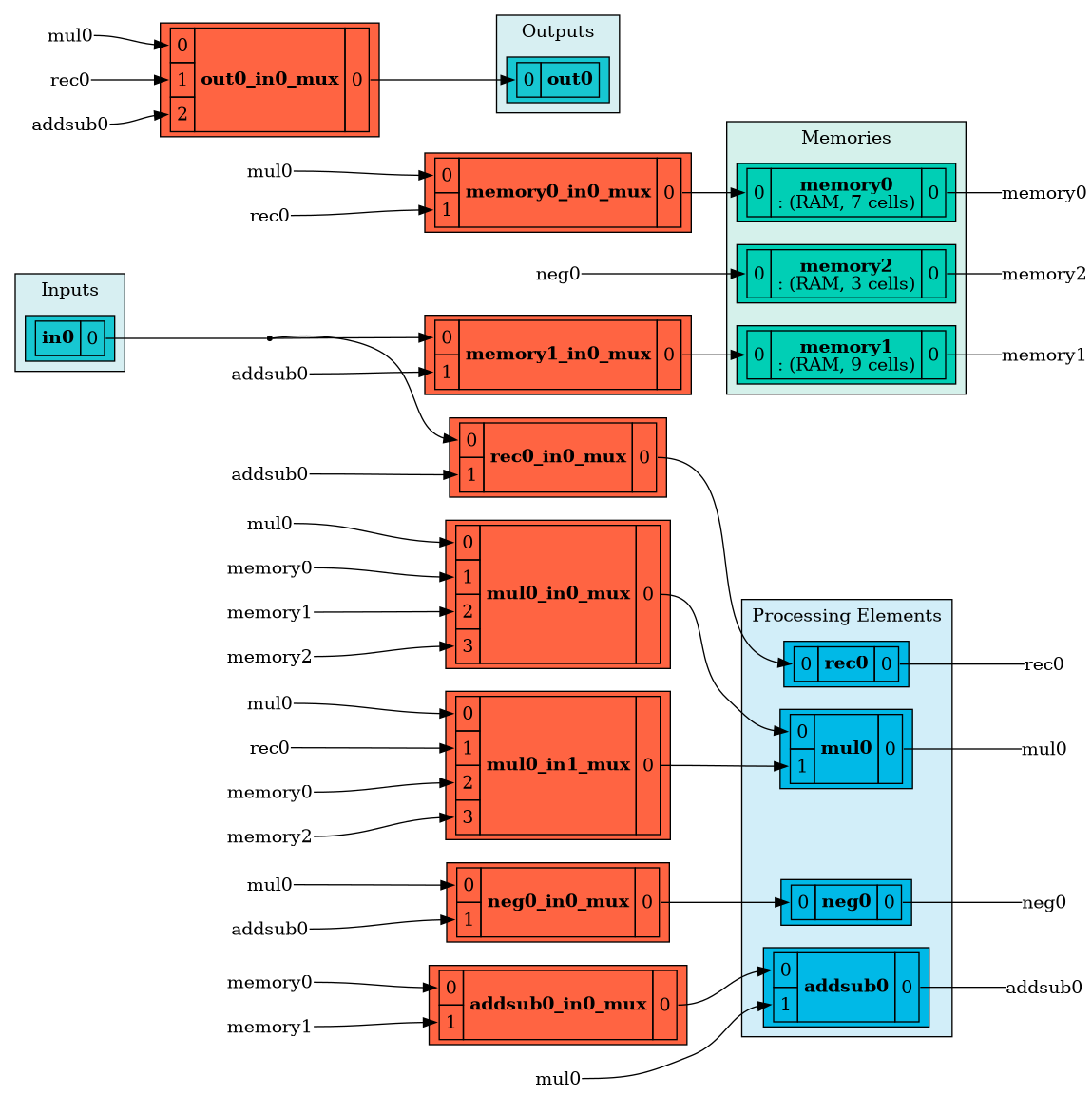
Derive an architecture with the minimal amount of PEs, memories, and minimal mux complexity
from b_asic.resource_assigner import assign_processing_elements_and_memories
from b_asic.architecture import Architecture

# Resource assignment
pes, mems, direct = assign_processing_elements_and_memories(
    schedule,
    strategy="ilp_min_mux",
    memory_read_ports=1,
    memory_write_ports=1,
    memory_total_ports=2,
    memory_type="RAM",
    max_mux_size=4, # set the maximum number of multiplexer inputs
)

# Create an architecture
arch = Architecture(pes, mems, "matinv", direct)
arch
Generate VHDL code, targeting single-precision floating-point arithmetic and using AMD Floating-Point IP cores. Some additional options are specified to demonstrate the configurability of the code generation.
from b_asic.code_printer import VhdlPrinter
from b_asic.data_type import DataType, NumRepresentation

dt = DataType(
    wl=(8, 23),
    num_repr=NumRepresentation.FLOATING_POINT,
)

printer = VhdlPrinter(dt)
printer.print(
    arch,
    path="generated",
    pe_registers = { # only generate 2 pipeline stages, the rest are inside the used IP
        "addsub": (1, 1),
        "mul": (1, 1),
        "rec": (1, 1),
    },
    fp_backend={ # specify backend for each floating-point operation
        "addsub0": "amd",
        "mul0": "amd",
        "rec0": "amd",
    },
    io_registers=True, # add registers to input and output ports
    pipeline_control=True, # pipeline control signals
)
/home/runner/work/b-asic/b-asic/galleries/examples/design_examples/matrix_inversion.py:99: UserWarning: pe_registers['mul'] requests 2 register(s) (1 input + 1 output) which is less than the operation latency of 'mul0' (6).
  printer.print(
/home/runner/work/b-asic/b-asic/galleries/examples/design_examples/matrix_inversion.py:99: UserWarning: pe_registers['rec'] requests 2 register(s) (1 input + 1 output) which is less than the operation latency of 'rec0' (19).
  printer.print(
/home/runner/work/b-asic/b-asic/galleries/examples/design_examples/matrix_inversion.py:99: UserWarning: pe_registers['addsub'] requests 2 register(s) (1 input + 1 output) which is less than the operation latency of 'addsub0' (9).
  printer.print(
The VHDL code has been generated in the “generated” directory, with the PEs containing instantiated AMD Floating-Point IP cores.
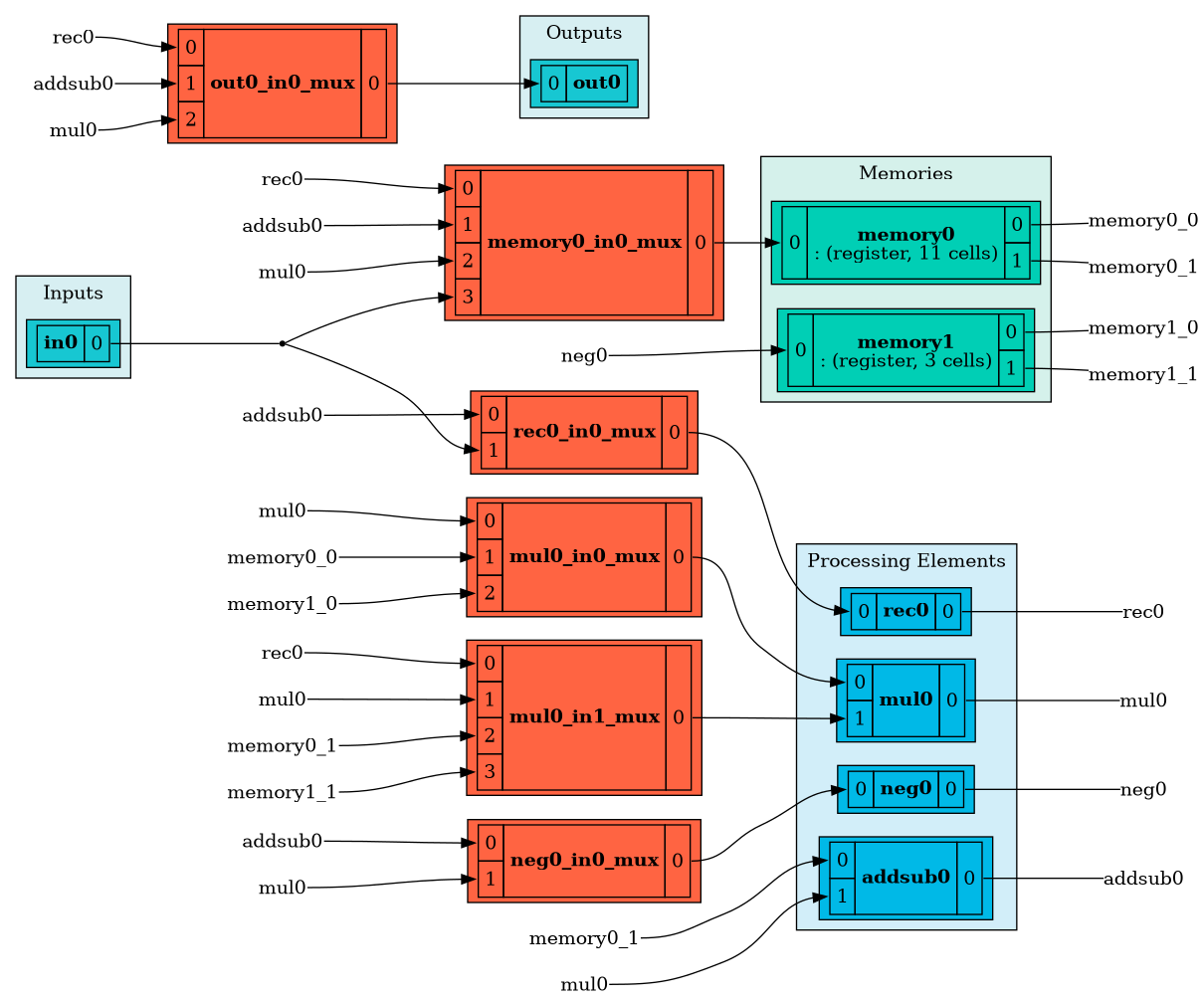
Derive another architecture from the same schedule, using register memories with two read ports and one write port. Three total ports allow both reads and the write to occur concurrently.
Total running time of the script: (0 minutes 1.168 seconds)