Note
Go to the end to download the full example code.
Streaming Matrix Transposition
In some systems, circuits for data-shuffling of streaming data are needed. Although not computational algorithms, data-shuffling circuits can be designed using B-ASIC.
Here, designs for streaming matrix transposition are derived. First lifetime diagrams for memory variables are generated and shown. Afterwards, the process exclusion graph is shown, and memory-cell sharing for a 4x4 streaming matrix transposer is illustrated. Finally, designs for a few different matrix sizes are generated using both memory-based (RAM) and register-based storage.
from pathlib import Path

import matplotlib.pyplot as plt

from b_asic.research.interleaver import generate_matrix_transposer
from b_asic.resources import ProcessCollection, draw_exclusion_graph_coloring


def plot_lifetimes(groups, schedule_time, colors):
    """Plot one row per group, keeping each element's colour consistent."""
    _, axes = plt.subplots(layout="constrained")
    for row, group in enumerate(groups):
        for element in group:
            ProcessCollection([element], schedule_time, cyclic=True).plot(
                ax=axes,
                row=row,
                bar_color=colors[element.name],
            )
    return axes


SIZE = 4
WL = 16 # Use fixed-point with 1 integer bit and 15 fractional bits throughout
output_dir = Path("generated")
output_dir.mkdir(parents=True, exist_ok=True)
Variable lifetimes
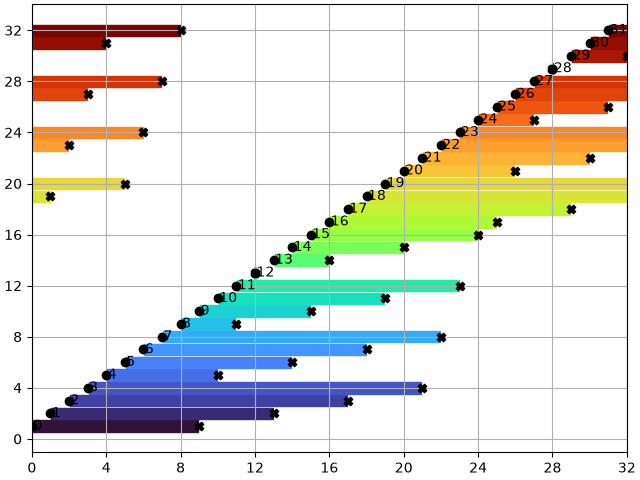
Samples arrive sequentially and leave in transposed order. Bars show how long each value must remain in storage. Labels identify arrival order, and colours stay consistent across all three diagrams.
example_collection = generate_matrix_transposer(SIZE)
elements = sorted(example_collection, key=lambda element: element.start_time)
element_cmap = plt.get_cmap("turbo", len(elements))
element_colors = {
    element.name: element_cmap(element_index)
    for element_index, element in enumerate(elements)
}

ax_lifetimes = plot_lifetimes(
    [[element] for element in elements],
    example_collection.schedule_time,
    element_colors,
)
Variable exclusion graph
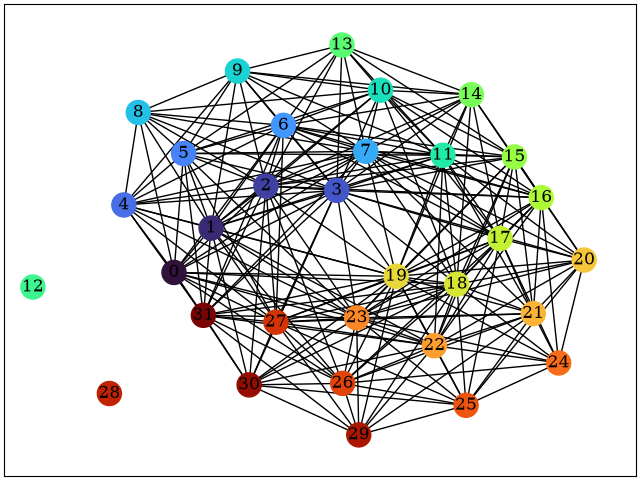
Nodes represent values. An edge means their lifetimes overlap, so the pair cannot share a memory cell.
exclusion_graph = example_collection.exclusion_graph_from_execution_time()
_, ax_exclusion = plt.subplots(layout="constrained")
draw_exclusion_graph_coloring(
    exclusion_graph,
    color_dict={element: index for index, element in enumerate(elements)},
    color_list=[element_colors[element.name][:3] for element in elements],
    ax=ax_exclusion,
    labels={element: element.name for element in elements},
)
Sharing memory cells
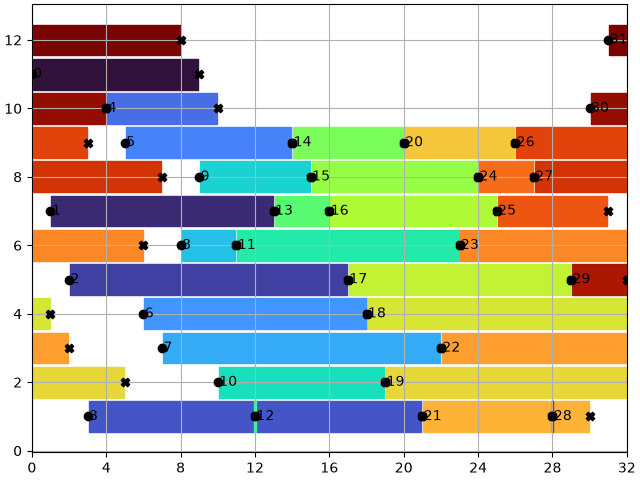
Graph colouring groups non-overlapping values into collections, one per memory cell. Each row now represents a physical cell.
# Split the values into groups with non-overlapping lifetimes
example_assignment = example_collection.split_on_execution_time(
    strategy="greedy_graph_color"
)
ax_assignment = plot_lifetimes(
    example_assignment, example_collection.schedule_time, element_colors
)
Generate memory-based VHDL
Generate RAM-based designs for the sizes below.
SIZES = ((2, 2), (3, 3), (4, 4), (5, 5), (7, 7), (4, 8))
for rows, cols in SIZES:
    # Generate memory variables for a matrix transposer
    collection = generate_matrix_transposer(rows, cols)
    # Split the collection into groups with non-overlapping lifetimes
    assignment = collection.split_on_execution_time(strategy="greedy_graph_color")
    # Generate VHDL for the streaming transposer using memory-based storage
    entity_name = f"streaming_matrix_transposition_memory_{rows}x{cols}"
    collection.generate_memory_based_storage_vhdl(
        filename=str(output_dir / f"{entity_name}.vhdl"),
        entity_name=entity_name,
        assignment=assignment,
        word_length=WL,
    )
Generate register-based VHDL
Same thing but using register-based storage.
for rows, cols in SIZES:
    collection = generate_matrix_transposer(rows, cols)
    entity_name = f"streaming_matrix_transposition_register_{rows}x{cols}"
    collection.generate_register_based_storage_vhdl(
        filename=str(output_dir / f"{entity_name}.vhdl"),
        entity_name=entity_name,
        word_length=WL,
    )
Total running time of the script: (0 minutes 0.940 seconds)