Note
Go to the end to download the full example code.
Deriving a polyphase FIR interpolator
Unfold a six-tap FIR filter by three, set two input phases to zero, and propagate those zeros to obtain a three-phase interpolator. The three outputs are consecutive samples of the interpolated signal, produced for each sample at the remaining low-rate input.
import numpy as np

from b_asic.core_operations import Constant
from b_asic.sfg import SFG
from b_asic.sfg_generators import fir
from b_asic.simulation import Simulation
Start with a small direct-form FIR filter. Six taps give two coefficients per phase when the interpolation factor is three.
coefficients = np.array([0.1, 0.2, 0.3, 0.4, 0.5, 0.6])
fir_sfg = fir(coefficients)
fir_sfg.input_operations[0].name = "x"
fir_sfg.output_operations[0].name = "y"
fir_sfg

Unfold by three. One iteration of the unfolded graph processes three consecutive input samples and produces three consecutive output samples.
factor = 3
unfolded = fir_sfg.unfold(factor)
unfolded
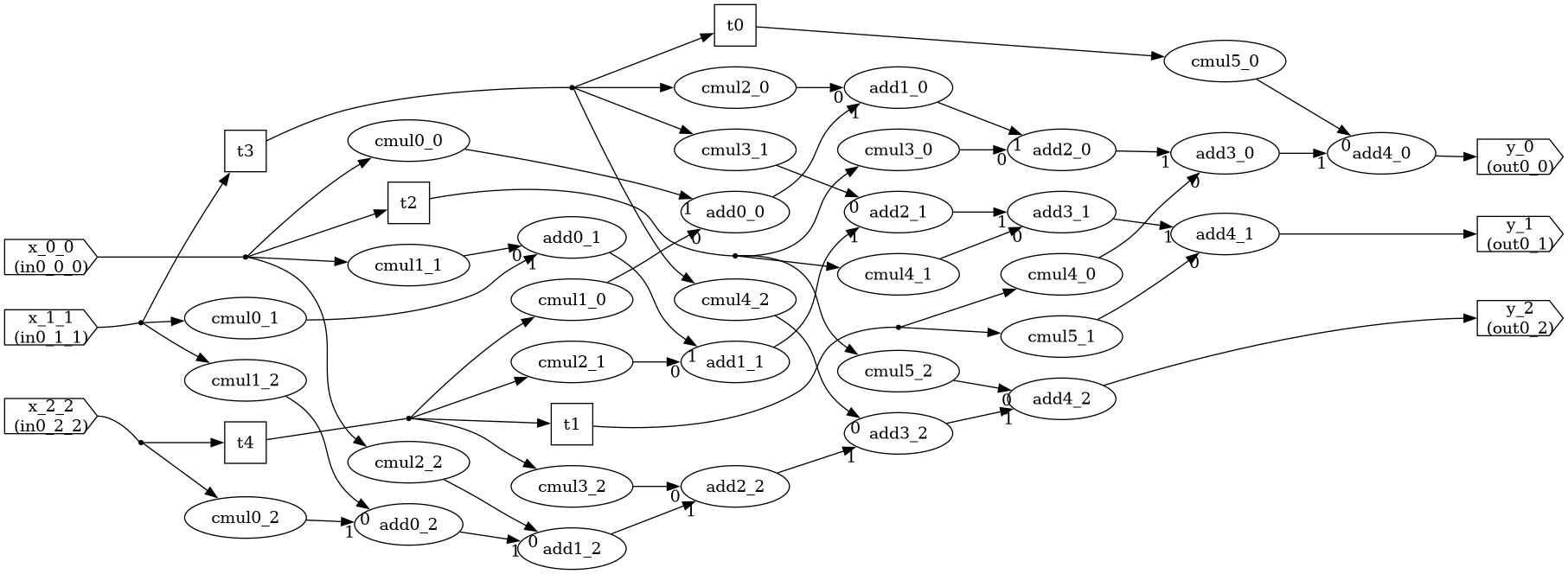
Zero insertion for interpolation keeps phase zero and sets phases one and two to constant zero. Remove those two unused input ports from the interface so the graph takes just one new sample per iteration.
zero_stuffed = unfolded
for input_operation in unfolded.input_operations[1:]:
    zero_stuffed = zero_stuffed.replace(input_operation.graph_id, Constant(0))
zero_stuffed = SFG(
    zero_stuffed.input_operations[0],
    zero_stuffed.output_operations,
    name="Zero-stuffed unfolded FIR",
)
zero_stuffed
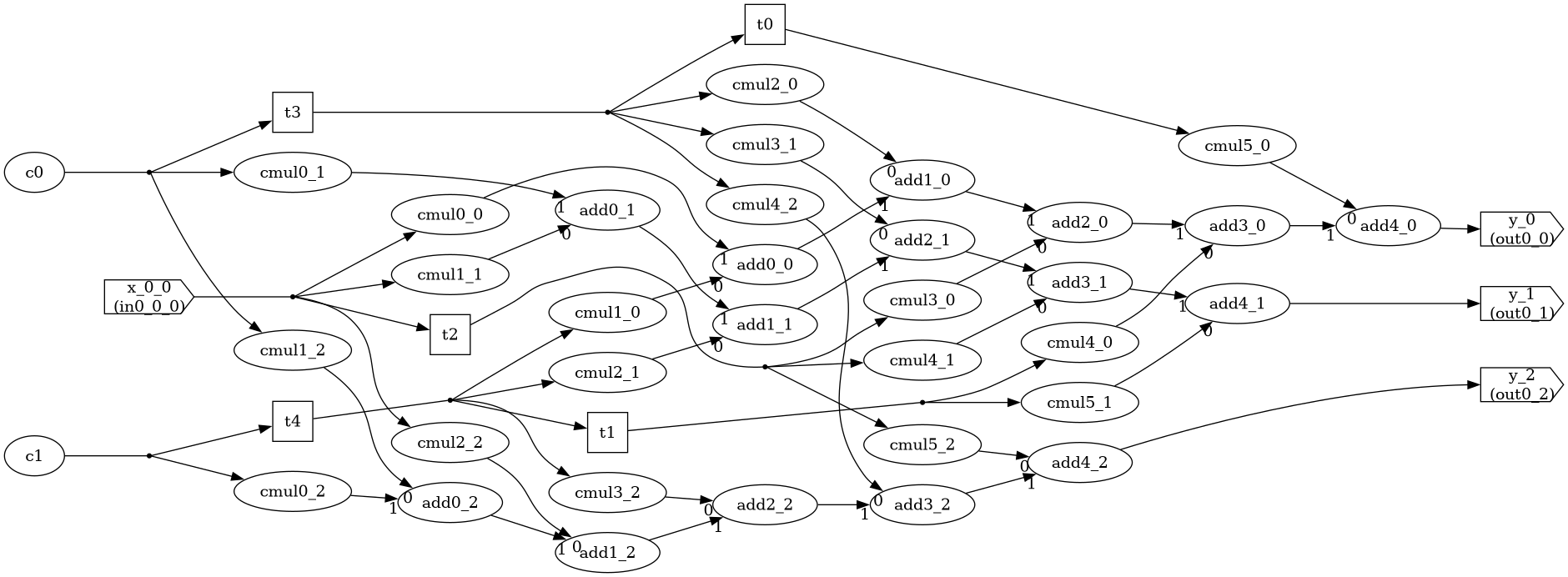
Propagate zeros through multipliers, additions, and zero-initialized delays. The result is a polyphase interpolator: output r uses coefficients h[r], h[r + 3], … and all three phases share the same low-rate input history.
polyphase = zero_stuffed.constant_propagation()
polyphase.name = "Three-phase FIR interpolator"
polyphase
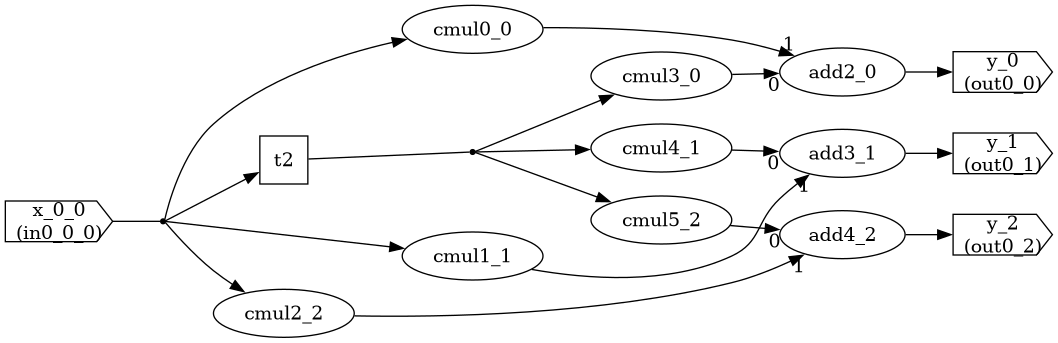
Verify the result against explicit zero insertion followed by FIR filtering. Append one low-rate zero to flush the two-tap polyphase branches.
samples = np.array([1.0, -2.0, 3.0, 0.5, 0.0])
simulation = Simulation(polyphase, [samples])
simulation.run()
phase_outputs = np.column_stack(
    [simulation.results[output.graph_id] for output in polyphase.output_operations]
)
interpolated = phase_outputs.ravel()

upsampled = np.zeros(factor * len(samples))
upsampled[::factor] = samples
reference = np.convolve(upsampled, coefficients)[: len(upsampled)]
np.testing.assert_allclose(interpolated, reference, atol=1e-14)
print("Polyphase outputs match zero insertion followed by FIR filtering.")
Polyphase outputs match zero insertion followed by FIR filtering.
Total running time of the script: (0 minutes 0.223 seconds)