Note
Go to the end to download the full example code.
Algorithmic Modelling
In B-ASIC, algorithms are represented as signal flow graphs (SFGs). Basically, a directed graph where nodes are operations that are connected by edges representing signals.
As a first example, let us build a simple 6-tap FIR filter, as it is a common and simple algorithm.
The FIR filter is defined by the following equation: \(y[n] = \sum_{k=0}^{N-1} h[k] x[n-k]\)
where \(x[n]\) is the input signal, \(y[n]\) is the output signal, \(h[k]\) are the filter coefficients, and \(N\) is the number of taps (in this case, 6).
The filter coefficients can easily be derived using other libraries, such as scipy.signal.
Algorithm
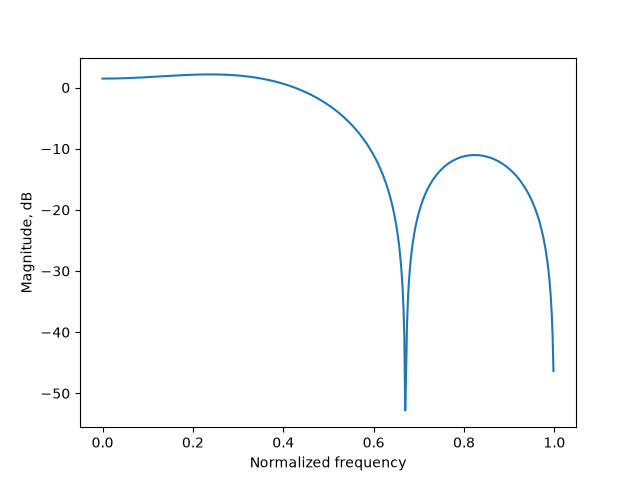
Let us use scipy.signal.remez() to design a low-pass filter with a cutoff frequency of 0.2 times the Nyquist frequency, and plot the magnitude response.
import matplotlib.pyplot as plt
import numpy as np
from scipy.signal import freqz, remez

h = remez(6, [0, 0.50 / 2, 0.6 / 2, 1 / 2], [1, 0])

fig, ax = plt.subplots()
w, h = freqz(h, [1])
ax.plot(w / np.pi, 20 * np.log10(np.abs(h)))
ax.set_xlabel("Normalized frequency")
ax.set_ylabel("Magnitude, dB")
Constructing the SFG
Let us now construct the SFG of this filter.
We start by defining the input and the delay elements to form the tapped delay line.
Then the <<= operator is then used to connect the these components together.
Finally, the output is defined as according to the FIR equation.
from b_asic import SFG, Delay, Input, Output

x = Input(name="x")
d0 = Delay(name="d0")
d1 = Delay(name="d1")
d2 = Delay(name="d2")
d3 = Delay(name="d3")
d4 = Delay(name="d4")
d5 = Delay(name="d5")

d0 <<= x
d1 <<= d0
d2 <<= d1
d3 <<= d2
d4 <<= d3
d5 <<= d4

y = Output(
    h[0] * x + h[1] * d0 + h[2] * d1 + h[3] * d2 + h[4] * d3 + h[5] * d4 + h[6] * d5,
    name="y",
)
The SFG is then constructed by passing its inputs and outputs.
fir = SFG([x], [y], name="6-tap FIR")
As possible for most objects in B-ASIC, the SFG can be rendered in an enriched shell,
by simply writing its name.
Otherwise, show() can be used.
fir

Total running time of the script: (0 minutes 0.115 seconds)